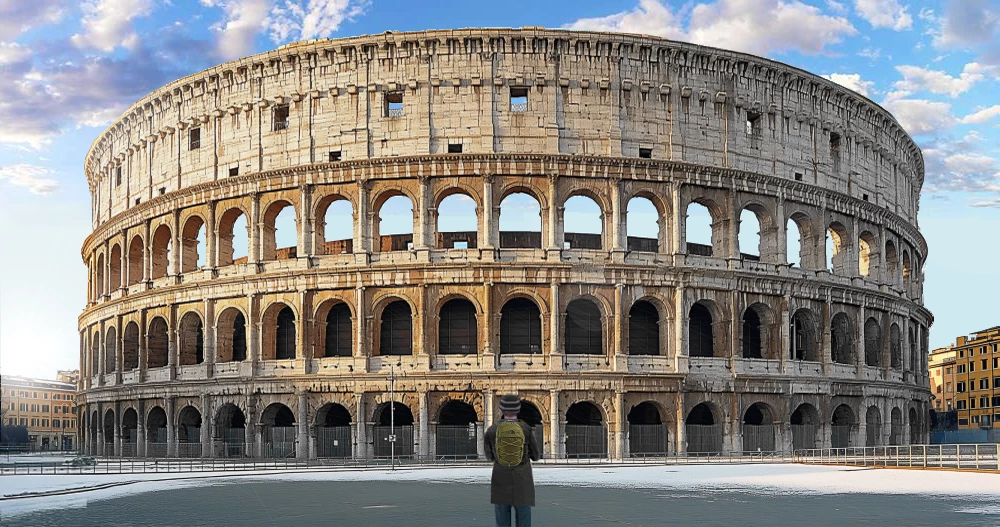
The History of the Imperial Forums and the Roman Forum: Two Thousand Years of Power
Few places on earth condense so much history into such a small space. The Imperial Forums and the Roman Forum recount, stone by stone, the entire arc of Roman civilisation: from the founding of the city on the Palatine Hill, through the Republic and the Empire, to the slow medieval dissolution. Visiting this archaeological complex means walking literally upon the accumulated layers of two thousand years of Western history.
The Roman Forum — the Forum Romanum — is the oldest. Its origins date to the 7th–6th century BC, when the valley between the Capitoline, the Palatine and the Quirinal hills was drained and transformed into a public square. For centuries it was the absolute centre of Roman life: here popular assemblies were held, justice was administered, military triumphs celebrated, and politics debated. The expression "going to the Forum" meant for a Roman what "going into town" means for us today.
From the Roman Forum to the Imperial Forums: The Expansion of Power
As Rome grew in population and political weight, the Roman Forum soon proved insufficient. It was Julius Caesar, in 54 BC, who inaugurated the era of the Imperial Forums by constructing the Forum of Caesar, the first in a series of monumental spaces designed to glorify the personal power of the emperors. After him, Augustus, Vespasian, Nerva and Trajan — each with increasingly grandiose ambitions — progressively expanded the forum complex to the north-east, creating what has become one of the most extraordinary concentrations of monumental architecture in the ancient world.
- Forum of Caesar (54–46 BC): the first of the imperial forums, with the Temple of Venus Genetrix, mythological mother of the gens Iulia
- Forum of Augustus (2 BC): the most elaborately ideological, with the Temple of Mars Ultor and statues of Roman heroes
- Forum of Vespasian or Forum of Peace (75 AD): built to celebrate the victory in the Jewish War and to house the treasures of the Temple of Jerusalem
- Forum of Nerva (97 AD): also known as the "Transitory Forum" for its connecting function, with the Temple of Minerva
- Forum of Trajan (112 AD): the most grandiose of all, with Trajan's Column, the Markets of Trajan, the Basilica Ulpia and two libraries
Together with the Roman Forum, these six spaces form an urban system unique in the world: approximately 2.5 square kilometres of monumental public architecture, whose construction spanned almost two centuries and involved tens of thousands of workers.
Decline and Rediscovery
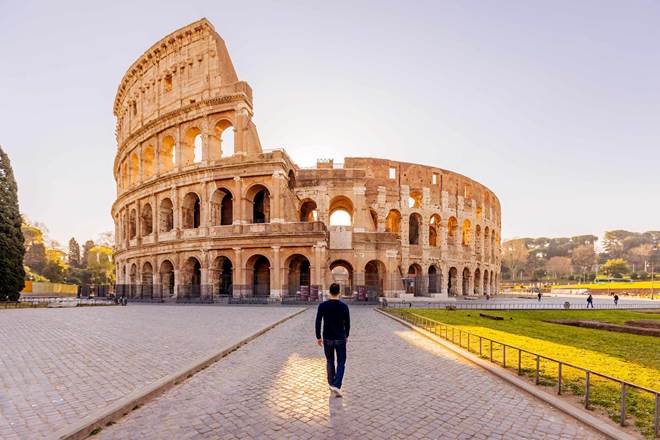
With the fall of the Western Roman Empire in 476 AD and the subsequent barbarian invasions, the Forums began a long decline. In the Middle Ages they became quarries for building materials: marble columns ended up in churches, blocks of travertine in palaces. The Roman Forum was known to medieval Romans as Campo Vaccino — the field of cattle — because it had been reduced to pastureland. The Via Sacra was buried under metres of debris, and the columns of temples barely emerged from the earth like relics of a forgotten world.
Systematic excavations began in the 18th and 19th centuries, first during the Napoleonic period and then under the Kingdom of Italy. Mussolini, in 1932, had the Via dei Fori Imperiali built — demolishing entire medieval and Renaissance districts — to link Piazza Venezia to the Colosseum for the regime's rallies. A town-planning decision that historians and urbanists debate to this day, but one that has made the Forums accessible and visible to millions of visitors.
Excavations continue even now: it is estimated that only 40–50% of the site has been brought to light. Beneath the Via dei Fori Imperiali, beneath the pavements and surrounding car parks, intact portions of Roman buildings still lie waiting to be discovered.